By Ali Iqbal
My name is Ali Iqbal, and I am an undergraduate student at Wayne State University in Detroit, Michigan. I am working on a project called GLEAC (Great Lakes Environmental Advocacy Collaboratory) in collaboration with an interdisciplinary group of professors from Wayne State University and a team from the Michigan Environmental Council.
The project consists of a series of workshops and surveys that ultimately serve to bring together governmental agencies, nonprofits, and advocacy and indigenous groups from both Canada and the US that govern and protect the Great Lakes. This project seeks to understand what limits their collaboration, to ultimately remedy these issues.
In early May, to start off my internship, I helped with a project led by WSU and supported through the RU4M (About RU4M – Research Universities for Michigan).
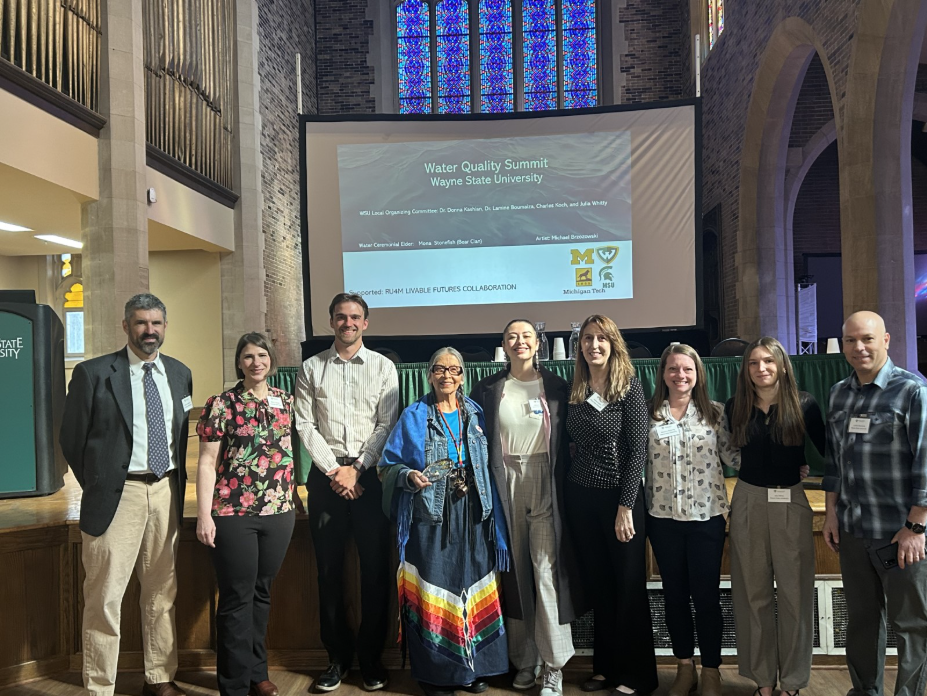
The above image shows leaders in science and policy from universities, nonprofits and indigenous groups at the Water Quality Summit at Wayne State University on May 12, 2026.
Wayne State University hosted a workshop that brought together members from all levels of government and academia to try to understand the emerging threats to our waters and where we currently stand on inter-agency collaboration, to benchmark what issues the project should highlight in both collaboration and in the environment today.
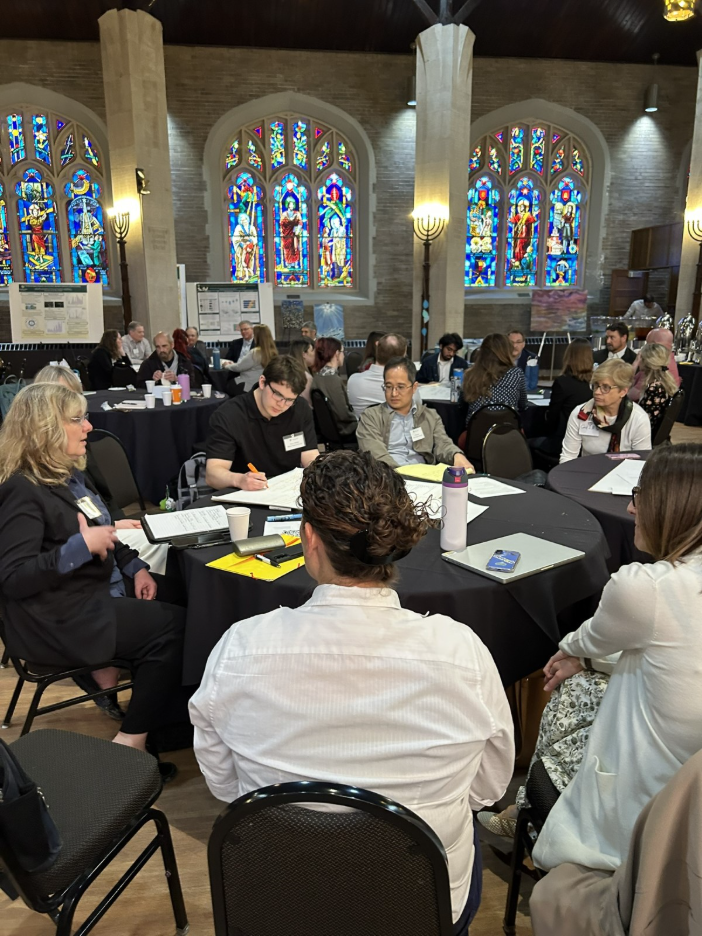
The above photo depicts participants at the May 12, 2026, conference collaborating in breakout groups, discussing emerging threats to our waters.
Aside from this, the project so far has been mainly cataloging and compiling these organizations and building a contact base for members. The next step will be to survey the individual members of these organizations to identify reasons they might struggle to collaborate with other organizations. My role in the project has mainly been finding contact information in order to distribute the survey.
More data that informed our survey was gathered at the IAGLR workshop in Winnipeg, held in late May. Areas of interest were how to ensure accountability and how to create robust but flexible agreements that are equitable to all parties. Questions from the upcoming survey will ask respondents to weigh in with their concerns surrounding these issues.
The results will be sorted and categorized, to unpack at several upcoming workshops in Escanaba, Michigan; Buffalo, New York; and Milwaukee, Wisconsin. Themes in collaboration and management so far have largely been identified as either:
- Not having enough information on how to solve emerging threats, and finding ways to direct scientists and lawmakers to address these threats.
- Not having enough public and indigenous outreach programs that would greatly aid in monitoring and management of the waters.
The main draw of this project for all members involved is its interdisciplinary nature. Team members from Wayne State University include Dr. Kristin Taylor (a professor of Political Science), Hassan (a student of Environmental Science), and me (pursuing a BS and a BA in Biology and Philosophy). Other project members are Donna Kashian (Biology); Shawn McElmurry (Civil and Environmental Engineering); Matt Seeger (Communication); and Rick Smith (Social Work). Conan Smith and Abby Wallace from the Michigan Environmental Council are also contributing their expertise, as is Anneke Smit (Law) from the University of Windsor.
This project brings together political and cultural analysis, as well as requiring a thorough understanding of the science behind environmental problems and their solutions. This is certainly a complex project requiring expertise in many areas to unpack.
We have been making active progress not only on ensuring the success of this project, but also on how to better our own collaboration in the interdisciplinary team leading this project. Our team attended a professional development workshop on June 8th at Wayne State University where we identified our goals for collaboration and how best to achieve them.
Interdisciplinary experiences like these are crucial for scientists in training to broaden perspective and collaborative ability and gain insight into how information from one field can be used in another. I hope to pursue a PhD in pharmacology after graduating from Wayne State University, combining this experience, as well as experience in the aquatic toxicology lab of Dr. Donna Kashian, and applying it to medical science. I hope to improve upon drug efficacy while maintaining safe parameters for humans and the environment. This experience has helped me greatly in understanding how to collaborate with other scientists, especially in the context of safety and management.