
Playing Safely in the Water
From swimming to paddling, fishing to boating, Michigan is brimming with fun opportunities to play in the water. Before your next adventure, make sure you’re empowered with the knowledge and gear to keep everyone safe.
In any situation, it’s important to:
- Know your skill and comfort level.
- Get to know the water you’re playing in.
- Pay attention to your surroundings and companions.
Resources
- To be notified about in-person kayak safety classes in your area, sign up here.
- Beginner’s Guide to Safe Paddling (PDF)
- ACA “Smart Start for Safe Paddling” online course (English and Spanish)
- ACA “Smart Start for Safe Paddling” resources
- Float plan template
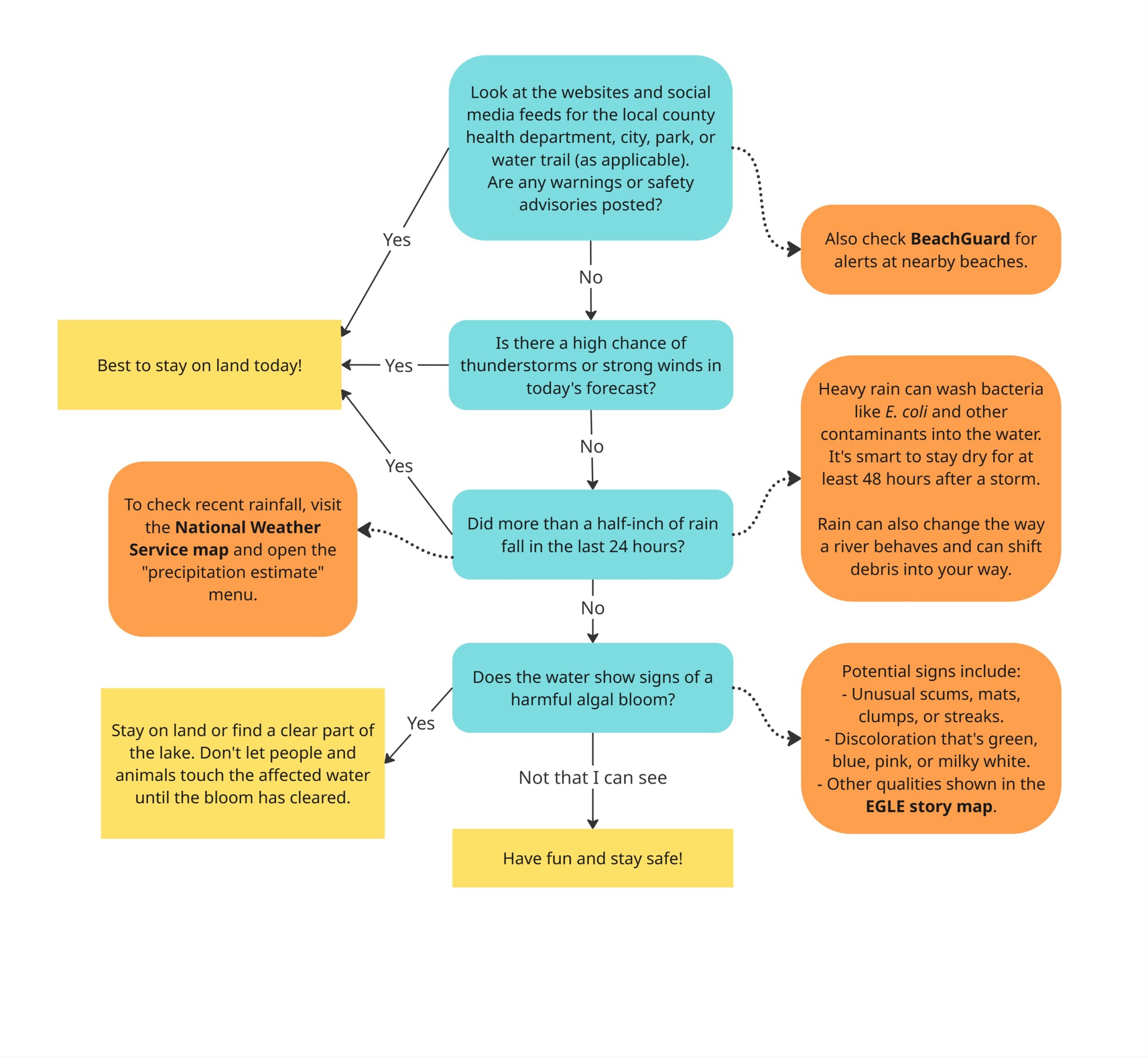
Is it safe to play in the water today?
Use this flowchart to make sure it’s a good day to swim, paddle, wade, or otherwise hang out in the water.
Flowchart links
Flowchart PDFs
Start here if you're planning to paddle!
Gear and know-how
Make sure you have the right gear and knowledge for a safe day on the water:
Whether borrowing, renting, or buying, do you have the right boat for your needs?
- If you’re paddling a Great Lake or middle of an inland lake: Opt for a sea kayak, which is longer, narrower, and better for waves and rougher conditions.
- If you’re paddling a river or along the shore of an inland lake: Go with a recreation kayak, which is shorter, wider, and more comfortable.
- Other factors to consider:
- Kayaks can come in youth and adult sizes.
- Tandem kayaks have room for two paddlers.
- Sit-on-top kayaks are good for activities like birdwatching or photography.
- Inflatable kayaks are nice for a leisurely paddle, while hardshell boats can be sturdier and more maneuverable.
- Whitewater paddling requires specialized boats, gear, and safety training. Unless you check all those boxes, aim for rivers rated Class I or II. Learn about river classifications.
- Have you brushed up on safety tips from the American Canoe Association (ACA)?
- Can you recognize common river hazards?
- Go slowly and carefully watch the river ahead. Try to avoid obstacles, or head to shore and carry your boat around them.
- Bends: water speeds up on the outside of a bend.
- Strainers: fallen trees, bridge pilings, boulders, or anything else that lets water flow through it while trapping larger objects (like your boat).
- Sweepers: branches, roots, or other overhanging obstacles that can tangle you or your gear.
- Low-head dams: hazardous low-profile structures that might not be marked or clearly visible on the surface.
Check the conditions
Make sure today is a good day for paddling:
- Did you check for advisories or closures at nearby beaches?
- Paddle launches aren’t typically monitored for E. coli and other contaminants. Check BeachGuard from Michigan EGLE to look for warnings at nearby monitored beaches.
- If there’s a local closure for E. coli or harmful algal blooms, stay on shore.
- Has it been particularly dry or rainy lately?
- Check recent rainfall with this National Weather Service map (open the “precipitation estimate” menu).
- If it’s been dry: Water levels might be low, putting you closer to submerged rocks and woody debris. Go slowly and watch the river carefully.
- If it’s been rainy: Heavy rains and high water can introduce and move woody debris. Even if you’re familiar with this river, go slowly and watch the river carefully.
- Local watershed or river trail groups might have updated information about woody debris and obstacles. Check their websites and social media channels or contact them directly.
- Have you checked on the water temperature and intensity of the river’s current?
- A nearby paddling livery, outfitter, or river group might have this information.
- Temperature: Cold water is risky even for the hardiest paddlers. Dunking in water that’s 50-60 degrees can put you at risk of heart attack, hypothermia, and worse. If the water temperature is below 60 degrees, buy, borrow, or rent a tight-fitting wetsuit or a looser, watertight drysuit.
- Flow intensity: USGS stream gauges monitor flow and sometimes temperature. Here are easy tips for finding this information online. Everyone has their own comfort level for river flow intensity. Look at stream gauge data for spikes in recent flow rates — which could signal that the water is running too quickly for an enjoyable, safe paddling experience — or ask a nearby outfitter or river group for input.
- Did you check on wind speed and direction?
- Download the Windy app to gauge wind strength and whether it’s blowing toward or away from shore. Aim for wind speeds less than 10 knots.
- Have you conveyed your paddling plans to someone who’s staying on shore?
- Tell someone the route you plan to take, what time you plan to leave and return, and who else you’re paddling with. Check in with them when you’re back safe on shore. Find a sample float plan on the Paddle Safe Twin Ports website.
- Consider using an app like Strava to track your movements and provide real-time location information to help rescuers find you in case of emergency.
Time to stay safe on the water!
Time to stay safe on the water!
- Are you wearing your lifejacket?
- Don’t just bring it — wear it, and make sure it’s fastened and snug. In addition to keeping you afloat, life jackets make you easier to rescue. So keep yourself and those around you safe by wearing your life jacket at all times.
- Do you have anything tied or looped to yourself or your boat?
- Items like lanyards, necklaces, and tow ropes could get tangled and harm you or other paddlers. Anything tethered to you or your boat must have a quick-release clip or latch.
- Is there foam on the water or along the shore?
- Some foam occurs naturally when wind and waves whip up organic compounds in the water. Foam can also contain PFAS, a potentially harmful chemical, or different types of bacteria. Stay on the safe side: avoid touching foam. If you do, rinse off in clean water. Learn more about PFAS foam on lakes and streams.
- Did you clean, drain, and dry?
- When you’re done paddling, make sure to clean, drain, and dry your boat, paddle, and all other gear to avoid aquatic invasive hitchhikers.
Swimming safety checklist
- Before you go: did you check on beach conditions? These are often available through city or county websites or social media pages, or from local weather stations.
- Are there any signs, red flags, or warnings about waves, currents, E. coli, or algal blooms? You should still be able to play safely on the beach!
- Are there motorboats or jet skis in the area? Watch for signs or buoys that mark boating channels, and stay in designated swimming areas.
- Do you have a lifejacket for every child and for people who are less experienced swimmers?
- Are you free from lanyards and tethers? Don’t tie anything to yourself for safekeeping. Lanyards and tethers can tangle in debris or drag you with a current. Anything that could wash away should be safely stowed on shore.
- Is someone staying on shore to watch the swimmers? If not, does everyone have a designated buddy and a commitment to frequently checking in?
- Do you see any foam on the water or along the shore? Some foam occurs naturally when wind and waves whip up organic compounds in the water. Foam can also contain PFAS, a potentially harmful chemical, or different types of bacteria. Stay on the safe side: avoid touching foam. If you do, rinse off in clean water. Learn more about PFAS foam on lakes and streams.
- Are there bridges over the water? Make sure no one climbs onto or jumps off the bridge. Potential risks from passing trains, car traffic, or unseen hazards under the water’s surface could cost you your life.
- Are there signs posted about swimmer’s itch? Are you sharing the water with ducks and geese? Swimmer’s itch is an itchy skin rash caused by tiny parasites in some lakes and ponds. The parasites are harmless to humans but cause allergic skin reactions. To reduce the chance of itchiness, vigorously rub your towel over your body, especially your legs, right after coming out of the water.
- Will swimmers have access to a hose or shower to rinse off?