Every lake is different, but Michigan’s inland waters increasingly have one challenge in common: nuisance and harmful algal blooms (HABs).
In a recently recorded webinar, “HABs 101: Lake Stories,” Michigan Sea Grant and state partners invited Michiganders to share first-hand experiences with inland lake blooms and the actions they’re taking to keep their communities healthy and safe.
In “Part 1: Managing nutrients from the inside,” Michigan Sea Grant Director Silvia Newell explained the importance of building a nutrient budget for lakes experiencing algae issues. She walked through a menu of potential nutrient and algae management tactics, such as dredging, aeration, and phosphorus-binding treatments.
Here, in Part 2, two sets of lake residents share their first-hand experiences with collecting data, tracking water quality patterns, and taking meaningful management actions.
Getting the numbers on Little Long Lake
Therese and Jim Shiffler live on Little Long Lake, a 154-acre springfed lake that straddles southern Michigan and northern Indiana. Little Long Lake is part of the highly agricultural watershed that feeds the Western Lake Erie Basin — and its notorious annual algal blooms.
When Little Long Lake’s residents started noticing their own slew of water quality and clarity issues, the Shifflers and their neighbors put their heads together to create a task force. Since Jim and Therese do not have a background in aquatic biology or limnology, the study of lakes, they reached out for assistance. The task force partnered with a neighboring lake’s larger and more established association for advice and connections. They also started building contacts with county conservation districts, health departments, local governments, and state natural resources agencies in both Indiana and Michigan. Attending meetings and conferences and taking online courses expanded their knowledge. A contact at the Michigan Department of Environment, Great Lakes, and Energy (EGLE) helped them dig up a decade-old management plan for their watershed.
Through their contacts and courses, the task force knew they needed to make a nutrient budget for Little Long Lake. As explained in Part 1, this process involves regularly collecting water samples from points around the lake to uncover patterns in the movement of nitrogen and phosphorus. They could also collect other data that would show general trends in water quality.
Their local county lakes council and the Indiana University Clean Lakes Program helped the Shifflers start collecting water samples at the lake’s inlet that were sent to a laboratory to test for nutrient levels. The task force also started tracking water temperature, dissolved oxygen, and other data that can be collected in real time using simple probes. Thanks to their region’s climate, the task force collects some samples in fall, winter, and spring, in addition to the summer sampling calendar recommended by the lakes council and Clean Lakes Program.
As the task force was ramping up, Little Long Lake experienced its first recorded, confirmed algae bloom in June 2022. Blooms have continued to crop up, and task force volunteers now routinely send raw water samples to a laboratory to test for algal toxins, which can harm human and animal health. All observed and confirmed HABs reports go into the Michigan EGLE database and can be viewed on the state’s HABs map.
With three years of data in their spreadsheets and a fourth sampling season currently underway, the Little Long Lake neighborhood task force is beginning to see some patterns. There’s a correlation between rain events, rising nutrient levels, and subsequent harmful algal blooms. Even when blooms aren’t visible, some algae toxins still show up in water samples throughout the sampling season — likely released by rapidly growing algae populations that weren’t quite visible as a bloom.
The Little Long Lake task force is still gathering information and tracking the challenges they’d like to address. Thanks to their robust data sets, they anticipate applying for EGLE grants and recruiting EGLE staff to help with targeted water quality monitoring.
In the meantime, they’re talking to property owners around the lake and sharing action steps for preventing extra phosphorus from entering the water (for examples of these actions, visit Illinois-Indiana Sea Grant’s Lawn to Lake Midwest site). The Little Long Lake group is also thinking carefully about the aquatic plants growing along the lake’s shoreline. They see the value of encouraging native plants that help process nutrients, hold sediment in place, and provide habitat for other organisms living in the lake. Targeted treatment to remove problematic invasive plant species can help native species thrive.
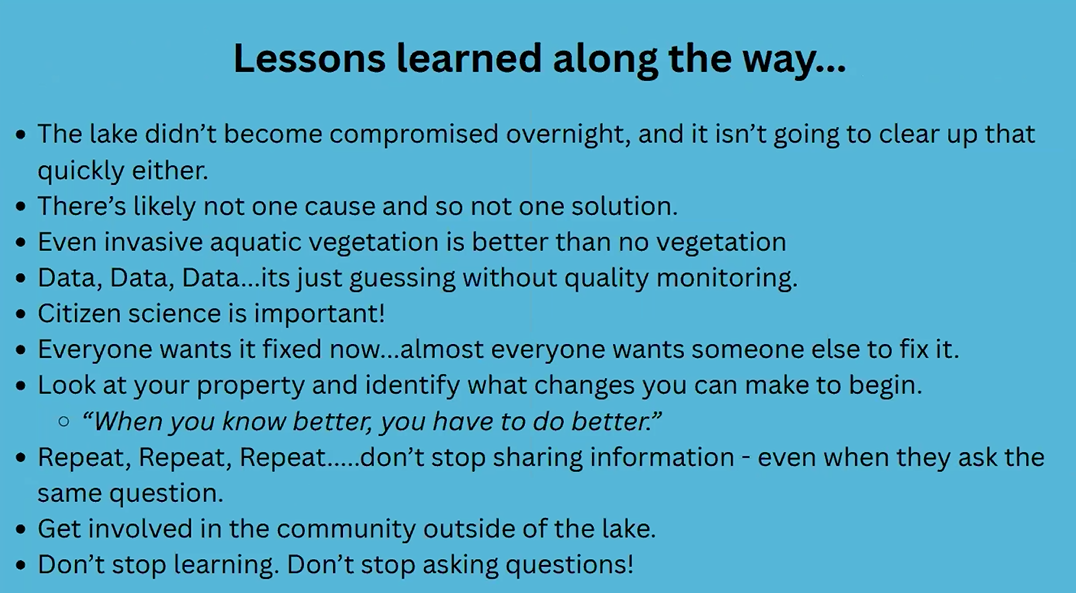
By building a team of peers and experts, Jim and Therese Shiffler have grown into their role as Little Long Lake’s stewards. “The three critical components of a watershed community are data, knowledge, and engagement,” they emphasized. They summed up their major takeaways on this slide:
For advice, resources, and training materials to dive into water quality testing in inland lakes, check out:
- Michigan State University Extension’s Introduction to Lakes online course
- MiCorps Cooperative Lakes Monitoring Program (CLMP)
- Local county conservation districts and watershed/river groups
Clearing up Spring Lake
The second “HABs 101: Lake Stories” presenter, Jim Walters, has lived on Spring Lake for 30 years. Spring Lake is a popular recreation destination in West Michigan. The 1,091-acre lake in Ottawa and Muskegon counties connects to Lake Michigan through the Grand River at Grand Haven.
Spring Lake’s management board formed in 1997. Members are mostly elected or appointed officials in surrounding counties and cities. Jim recently joined as the lakefront property owner representative.
Nuisance and harmful algal blooms are long-standing issues in Spring Lake. With an average depth of 18 feet, the lake is just deep enough for summer-warmed surface water to trap a layer of oxygen-depleted water along the bottom. As described in Part 1, anoxic water can release phosphorus held in the sediment, allowing it to enter the water column for use by blooming algae.
In 2005, the lake board treated the lake with alum to trap phosphorus in the sediment (see Part 1 for a refresher on p-binding treatments). Water sampling showed a significant drop in phosphorus levels, and the treatment worked as expected for about 15 years. Over time, however, phosphorus levels began rising again, and algal blooms and other water quality issues began to resurface.
After running a nutrient budget, the lake board determined that about half of Spring Lake’s phosphorus was coming from internal sources, so a fresh round of alum would have a good chance of success.
The lake board opted to deploy the treatment in early 2025 before the summer recreation season. With funds mostly raised through a municipal bond, the lake board hired a contractor to treat 650 acres of Spring Lake. The alum was dispersed from barges traveling along a GPS-guided distribution grid. Meanwhile, the lake board kept the community updated through newsletters, press releases, and an announcement on its website. They explained the rationale for the treatment and outlined its expected outcomes.
Treatment wrapped up before Memorial Day 2025. Samples collected in June showed a significant improvement in water clarity, and public feedback has been positive. As of August 2025, the lake board recorded no change to the lake’s pH, no fish kills, and no restrictions on recreational water use. They may need to spot-treat blooms in the shallow, still waters of Spring Lake’s many bayous. But they hope the alum treatment can keep algae blooms at bay in the main lake for another 15 years.
Meanwhile, the lake board has formed a technical committee and is laying the groundwork to update watershed management documents and secure external funding for future water quality work.
Learn more about the Spring Lake board and explore years of sampling data at www.springlakeboard.org/.
Keep your loved ones and pets safe around a HAB
- If there’s a sign about a HAB advisory or closure, follow the instructions.
- Avoid wading, boating, fishing, or swimming in water with a visible bloom. When in doubt, stay out.
- Keep pets from touching or drinking the water.
- Blooms can grow and fade quickly and may drift around with wind and waves.
- Once the water is clear, it’s generally safe to touch.
Catch up on previous HABs 101 webinar recordings to learn about fundamentals about HABs, common nuisance algae species in Michigan, and prevention and management strategies. Explore more HABS resources and see a map of past and present HABs recorded in Michigan.