Michigan Sea Grant’s Teaching Great Lakes Literacy (TGLL) program connects scientists and educators to co-develop data-driven lessons that engage students with Great Lakes topics and community stewardship.
Michigan Sea Grant Extension Educators Brandon Schroeder, Meaghan Gass, and Angela Scapini launched TGLL in 2023, drawing inspiration from similar work led by Oregon Sea Grant. They secured a $160,000 grant from the Great Lakes Fishery Trust to design and pilot the program.
As co-leads and active participants in the Sea Grant Center for Great Lakes Literacy (CGLL), the three Extension educators tapped into a robust network of teachers for TGLL’s first cohort. They primarily focused on middle and high school science and math teachers and encouraged educators to apply in pairs from the same schools.
The 2023-24 cohort of 17 educators and 11 scientists focused on Lake Huron-related topics, such as native lake sturgeon, harmful algal blooms, and aquatic invasive species. The TGLL team facilitated workgroup meetings, supported lesson development, and helped pilot lessons with students. Each educator received $2,000 stipends to fund their time and support student learning experiences.
The second cohort of 16 educators and 12 scientists spent 2024-25 creating lessons focused on Lake Michigan, with topics like water quality, fisheries, and the Muskegon Lake Area of Concern. Without funding for additional cohorts, the TGLL team is now focusing on reviewing lessons for final development. These standards-aligned, field-tested lessons will be available for free in the CGLL resource library. The first completed lesson, featuring harmful algal blooms, is available now: Buoy, is that water green!
Between the two program years, 32 educators and 18 researchers developed 14 lessons and reached more than 2,340 students. They forged new connections with peers and developed meaningful lessons for youth across Michigan, Wisconsin, and Indiana.
One participant said, “I learned a great deal about my specific topic (aquatic invasive species) and was able to teach what I was learning to my students right away.” Another stated, “I appreciated working with knowledgeable people to create authentic, hands-on learning experiences that enhance curriculum about freshwater and the Great Lakes.”
Researchers saw their data making a real-world difference and gained valuable experience in translating their work for fresh audiences.
Out of school, off to the beach
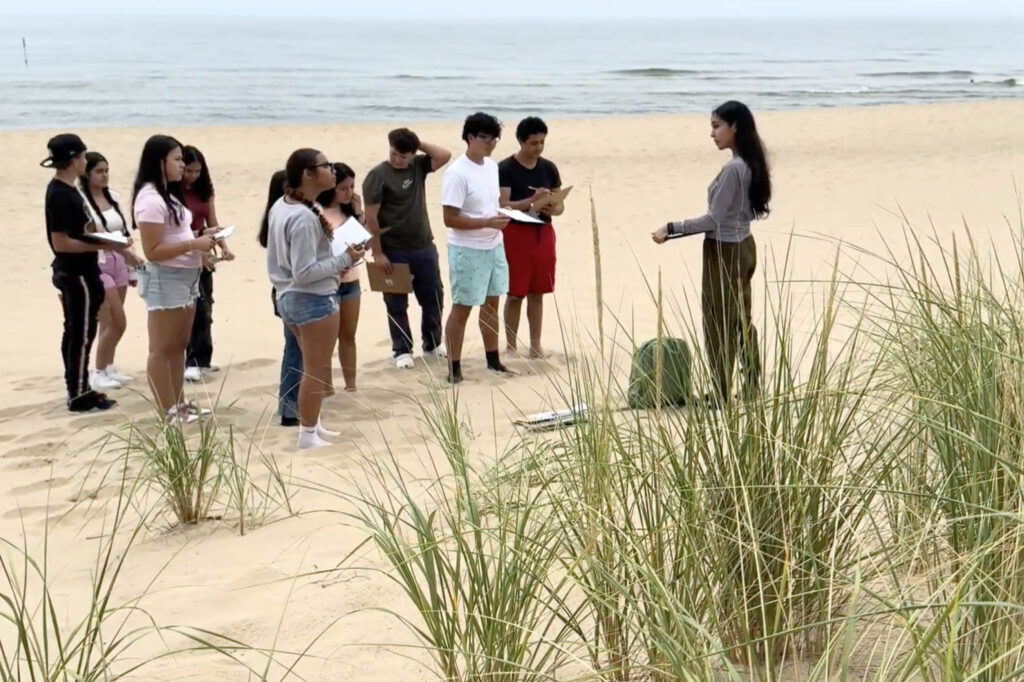
Field-testing lessons with students is a crucial aspect of the TGLL program. In May 2025, agriscience students from Careerline Tech Center (Ottawa Area Schools) waded into Lake Michigan’s coastal waters with fisheries experts from the Michigan Department of Natural Resources, NOAA’s Great Lakes Environmental Research Laboratory, and the Little River Band of Ottawa Indians. Their mission: survey juvenile lake whitefish populations — a species vital to Michigan’s economy, culture, and tribal heritage. Students learned firsthand how environmental changes affect fisheries and food systems, connecting classroom lessons to real-world sustainability issues.
September found another group of students from Holland High School at the beach exploring the shifting sands of Oval Beach in Saugatuck. Partnering with Michigan State University’s Coastal Processes and Geomorphology Laboratory, students used tablets and satellite mapping tools to study dune evolution and human impacts on coastal landscapes. These immersive experiences sparked curiosity and deepened understanding of how natural processes and human activity shape Great Lakes ecosystems.
The power of educational partnerships
Educators increasingly seek real-world, standards-aligned, data-based science lessons — especially those tied to the Great Lakes. The shift to Next Generation Science Standards (NGSS), and Michigan Science Standards (MSS), coupled with persistently low national science proficiency levels, underscores the need for engaging and supporting educators and youth in meaningful science education experiences.
TGLL integrates Great Lakes Literacy Principles, inquiry-based learning practices, and 3P (Place-, Project-, and Problem-Based) Learning strategies endorsed by the Great Lakes Stewardship Initiative (GLSI), and MiSTEM Network. TGLL outcomes have been shared at national and regional conferences, including the National Marine Educators Association (2024); National Place-Based Education Conference (2025); and Michigan Science Teachers Association (2026).
Key education partners included Michigan Department of Education, Michigan STEM Network, and GLSI.
Great Lakes science partners included the Michigan Department of Natural Resources Fisheries Division; Michigan Department of Environment, Great Lakes and Energy; Michigan State University Department of Fisheries and Wildlife; Michigan State University Department of Geography, Environment, and Spatial Sciences; National Oceanic and Atmospheric Administration (NOAA) Great Lakes Environmental Research Laboratory (GLERL); NOAA Great Lakes Integrated Sciences and Assessments (GLISA); NOAA-GLERL Great Lakes Aquatic Nonindigenous Species Information System (GLANSIS); EPA Great Lakes National Program Office; Great Lakes Observing System; Little Traverse Bay Bands of Odawa Indians; Inland Seas Education Association; Besser Museum for Northeast Michigan; Michigan Natural Features Inventory; and Michigan Nature Association.