
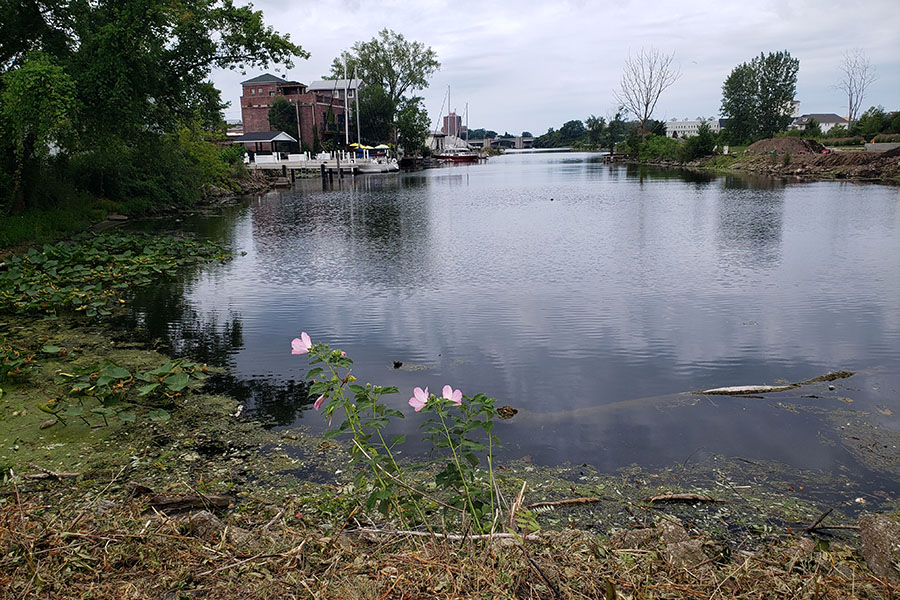
Compound flooding, caused by a combination of heavy rainfall and high water levels, has become an increasingly urgent challenge for coastal communities on the Great Lakes as lake levels fluctuate and storms intensify. A recent report from a partnership between researchers, community members, and Michigan and Wisconsin Sea Grant organizations investigated these risks in Benton Harbor, Michigan, and Milwaukee, Wisconsin. By integrating technical modeling with sociological data, the project provides a comprehensive look at how these Great Lakes cities can build resilience while addressing long-standing socioeconomic inequities.
Compound flooding occurs when heavy rainfall coincides with high lake levels, overwhelming traditional drainage systems and flooding low-lying areas. In the Great Lakes region, where lake levels fluctuate and storm frequency is increasing, this issue has become an urgent priority for municipal planners. The study focuses specifically on watersheds in Benton Harbor and Milwaukee, both of which face significant flood risks because of their geography and aging infrastructure.
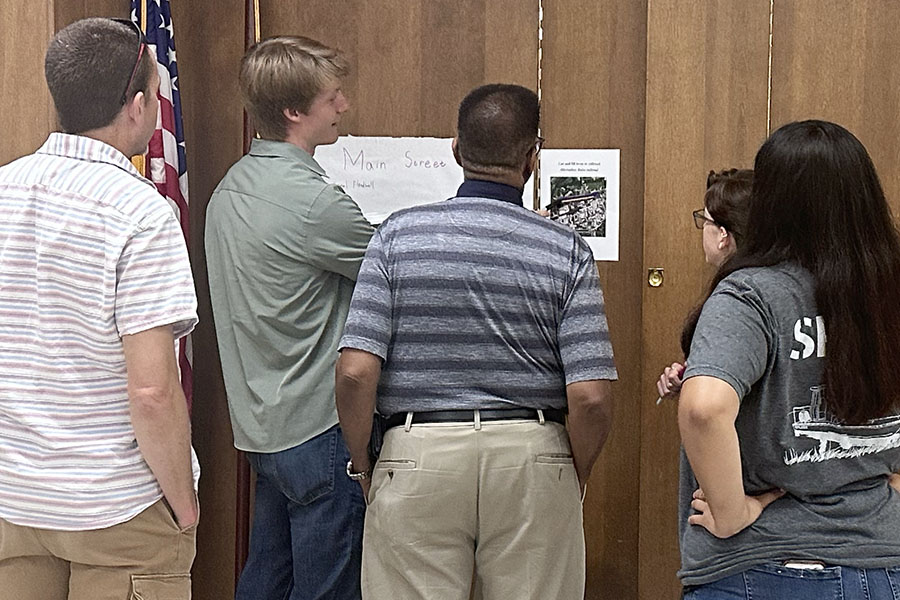
The core of the research involved uniting technical analysis combined with community perspectives. The team conducted a series of interviews with project leaders and city officials, and informal conversations with local residents in Benton Harbor and Milwaukee, culminating in a flood mitigation Stakeholder Advisory Board meeting in Benton Harbor. The team also used the CDC Social Vulnerability Index to map where flood risks overlapped with socioeconomically disadvantaged populations. This spatial analysis allowed the researchers to situate environmental risks within the historical context of each city.
The report, “Planning for More Equitable Implementation of Flooding Infrastructure in Berrien County, MI and Milwaukee, WI,” was led by a team of graduate students at the University of Michigan, including Kristen Bashen, Keyan Li, Jenny Miller, Adriana Nieto, Nathan Parr, and Riley Pohlman. Lauren Mullenbach, research manager at Michigan Sea Grant, and Mike Shriberg, professor of practice and engagement and director of the University of Michigan Water Center, oversaw the project.
Differing Priorities
Although there were many shared concerns among residents and local officials and experts, the results showed that priorities differed among the two groups. While residents focused on tangible community impacts, city officials and technical experts highlighted the systemic barriers to implementation.
One of the primary findings of the report is the shared concern among residents regarding the immediate physical effects of flooding. Community members expressed significant worry over inundated roadways and backed-up drains, which directly affect daily mobility and property safety. In addition, many were interested in solutions that involved infrastructure improvements and more green space.
Officials and experts, on the other hand, highlighted the importance of educating residents about solutions, technical guidance, and shared best practices, while citing funding limitations and coordination challenges across jurisdictions as persistent obstacles. There was a clear preference among the public for solutions that prioritize infrastructure improvements and the expansion of green spaces. Experts also noted that while technical guidance is available, persistent obstacles such as funding limitations and the difficulty of coordinating efforts across different jurisdictions often stall progress.
Solutions and Recommendations
The report offers several cross-cutting recommendations to bridge the gap between technical needs and community desires. A major suggestion involves re-aligning how cost-benefit analyses are conducted for flood mitigation projects. Historically, these analyses may not have fully accounted for the social value of a project or its impact on vulnerable populations. By shifting this valuation, cities can better justify investments in areas that need them most.
Another central finding is the effectiveness of hybrid gray-green infrastructure. This approach combines traditional engineering, such as pipes and pumps, with nature-based solutions like rain gardens and permeable pavements. This strategy not only manages stormwater more effectively but also provides the green space that residents value. Additionally, the researchers emphasized the need for systematizing equity into long-term maintenance planning, ensuring that flood mitigation infrastructure remains functional in all neighborhoods regardless of socioeconomic status.
For Benton Harbor, the study identified a specific need to prioritize high-visibility, publicly accessible spaces. This includes focusing on downtown roads, parks, and riverfronts that serve as the community’s heart. In Milwaukee, the recommendations lean toward improving transparency within the planning process and strengthening the partnerships between the city and its community organizations. These tailored strategies, categorized into short-, medium-, and long-term priorities, are designed to be actionable pathways toward a more resilient and equitable future for the Great Lakes region.
Project team members pose for a group photo.
Moving Forward
In summary, the research team recommended low-cost, high-visibility measures, green and hybrid infrastructure solutions, and planning for future maintenance needs and environmental changes, among others. The recommendations should be chosen to meet the needs of the community, provide co-benefits such as green space and recreation, and build capacity for maintenance, future mitigation efforts, and community partnerships.
As compound flooding worsens because of increasing temperatures and changing storm patterns, it has become imperative that local governments rise to the challenge of upgrading, replacing, or expanding aging flood mitigation measures. In Milwaukee and Benton Harbor, this challenge is complicated by a legacy of disinvestment and historical infrastructure solutions, such as the paving of waterways and now-defunct underground stormwater systems, that no longer serve the community.

