
Michigan Sea Grant recently launched nine new research projects with funding of nearly $1.5 million to track seasonal movements and populations of smallmouth bass in Saginaw Bay, investigate sand dune restoration and stabilization, study wild rice as a tool for ecological restoration, and other issues relevant to the Great Lakes.
These new projects will develop information, create tools, and build partnerships that will improve decision-making to address particularly challenging coastal issues in the state and fulfill critical research needs for the Great Lakes ecosystems.
“Michigan Sea Grant is funding projects that blend community-driven research, outreach, and education, allowing Great Lakes researchers to study these powerful ecosystems and communicate their findings to the individuals that rely on these systems for their livelihood or for recreation,” said Silvia Newell, Michigan Sea Grant director and professor at the University of Michigan School for Environment and Sustainability.
MISG has selected the following projects for funding in 2026-28.
Smallmouth bass in Saginaw Bay: Stock structure, seasonal movements, and effect of recreational tournament displacement. This research project will fill critical knowledge gaps on the spawning structure, long-term movements, and possible effects of displacement on smallmouth bass in Saginaw Bay. By integrating high-resolution acoustic telemetry and genomic analyses, the project will contribute new data and a transferable analytical framework to the broader body of Great Lakes fisheries science. These results will directly inform management decisions in Saginaw Bay and provide comparative insights applicable to other nearshore fish populations across the basin. Lead principal investigator: Scott Colborne, Michigan State University
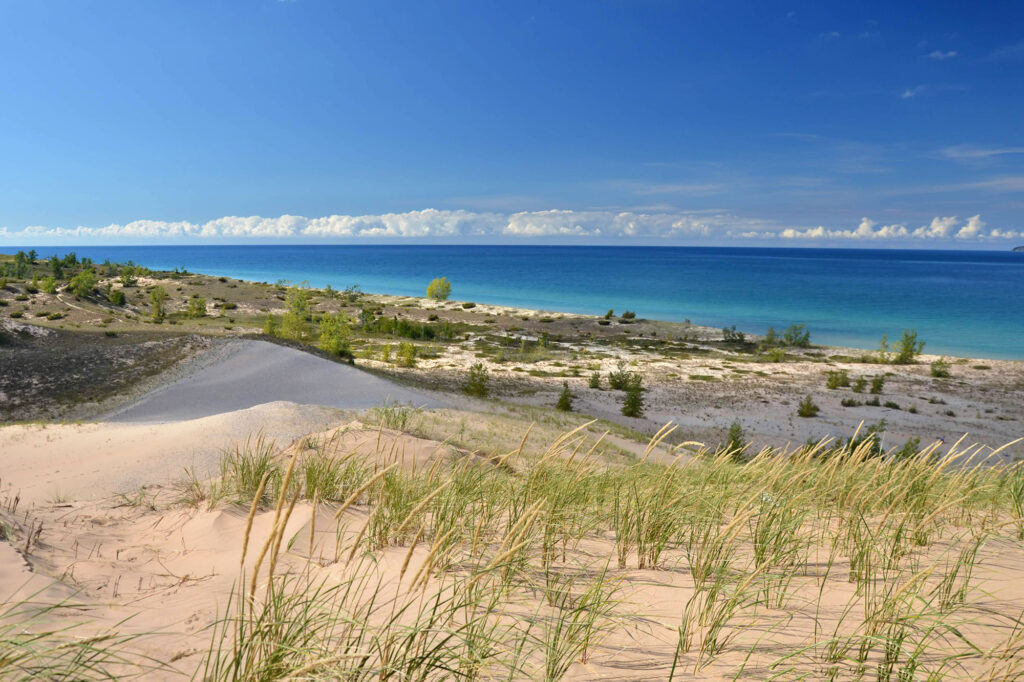
Assessing resilience of ecosystem-engineering plants for Great Lakes sand dune restoration and stabilization. Michigan’s iconic coastal dunes protect our shorelines, but the American beachgrass that stabilizes them faces growing environmental threats. This research project investigates how changing conditions impact dune integrity while testing innovative restoration strategies. By combining statewide field surveys with greenhouse experiments, scientists are evaluating the use of climate-adapted plants and beneficial soil fungi. These findings will provide land managers with science-based tools to build resilient coastlines and preserve these fragile Great Lakes ecosystems. Lead principal investigator: Erika Hersch-Green, Michigan Technological University
Sensitivity of invasive dreissenid mussels to freshwater acidification in the Great Lakes. Since the 1990s, invasive dreissenid mussels have completely transformed the Great Lakes and now comprise over 90% of the lake floor’s animal biomass. However, new threats are emerging as the lakes face rising temperatures and increasing acidification. This study will use controlled laboratory experiments to investigate how these environmental stressors are affecting algae and the feeding habits of quagga mussels. By understanding these shifts at the base of the food web, researchers can better predict and protect the future of Great Lakes fisheries and water quality. Lead principal investigator: Jenan Kharbush, University of Michigan
Assessing tire wear particles and rubber-derived chemicals in urban Great Lakes ecosystems. This project will examine tire wear particles and related chemicals in three urban rivers in southeastern Michigan and their outflows into Lake St. Clair, the Detroit River, and Lake Erie. Researchers will track where these pollutants go, whether they accumulate in fish, and how they may affect ecosystems. These findings will help state agencies develop pollution control strategies and bring attention to this under-recognized threat to the Great Lakes. Lead principal investigator: Zhijiang Lu, Wayne State University
Resource partitioning regulates epigenetic evolution among Lake Superior lake charr ecotypes. Lake Superior’s lake charr are unique, naturally sustaining themselves through four distinct ecological groups that use different habitats and food sources. This research explores how these diverse lifestyles trigger “epigenetic” changes, which are modifications to how genes are expressed without altering DNA. By studying fish near Isle Royale, scientists aim to witness speciation in action. This work reveals the biological mechanisms that allow one species to split into many, ensuring the Great Lakes’ biodiversity remains resilient. Graduate Research Fellow: Adele Shirmer, Michigan Technological University
The ethics of risk communication under uncertainty: A case study of PFAS mixtures and inter-agency environmental communication. This work will help establish communication strategies that prioritize transparency and integrity without overwhelming the audience. Findings will help scientific agencies tailor their messaging to ensure that all Michigan residents, regardless of their technical background, have the information they need to understand environmental risks and make informed decisions about their health and surroundings. Graduate Research Fellow: Alexandra Sexton, Michigan State University
Synergistic effects of acidification and temperature on Microcystis aeruginosa toxicity in the Laurentian Great Lakes. Harmful algal blooms are a growing threat to the Great Lakes, where they block sunlight, deplete oxygen, and produce toxins that contaminate drinking water. This research project will investigate how the combination of rising temperatures and lake acidification affects toxin production. By studying the balance between toxic and non-toxic strains, researchers aim to predict how future climate conditions will alter the safety and health of Great Lakes ecosystems, providing vital information for protecting regional water quality. Graduate Research Fellow: Colton Bragg, University of Michigan
Getting out of the rough: Understanding shifting perceptions and the emergence of burbot as a recreational target. Burbot in Lake Superior face rising recreational pressure despite declining nearshore populations and a lack of official harvest regulations. Since fishing peaks during winter spawning, this project integrates angler surveys with on-the-ground catch data from ice fishing locations. By combining stakeholder perspectives with biological population estimates, researchers aim to provide fisheries managers with the evidence needed to establish sustainable protections and ensure the long-term survival of this native Great Lakes predator. Graduate Research Fellow: Greyson Wolf, Michigan Technological University
Understanding drivers of wild rice proliferation in the Great Lakes: A stepping stone towards ecological restoration. Michigan is home to two distinct wild rice species that are vital to Great Lakes ecosystems and Indigenous cultures. Unfortunately, they are often managed as a single group, although preliminary data suggests they respond differently to environmental stressors. By conducting parallel experiments at two different Michigan sites, scientists will simulate various soil and water conditions to identify why wild rice is becoming increasingly scarce in southern regions. This study will provide updated population data and specific management insights, helping conservationists restore these irreplaceable plants and protect Michigan’s unique natural heritage for future generations. Graduate Research Fellow: Macy Gustafson, University of Michigan
Every two years, Michigan Sea Grant requests proposals for projects addressing issues affecting the Great Lakes and Michigan’s coastal areas. Funded projects are selected through a competitive process involving external peer review and advisory panel recommendations. The current round includes four research projects led by leading researchers in the region, and five graduate student fellowship projects led by the next generation of scientists and managers. Two of the projects are funded in partnership with the NOAA Ocean Acidification Program (OAP).
For a complete list of projects and more details, see our Research Projects page.

