By Shehnaz Hameed, a 2025 Michigan Sea Grant undergraduate environmental intern.
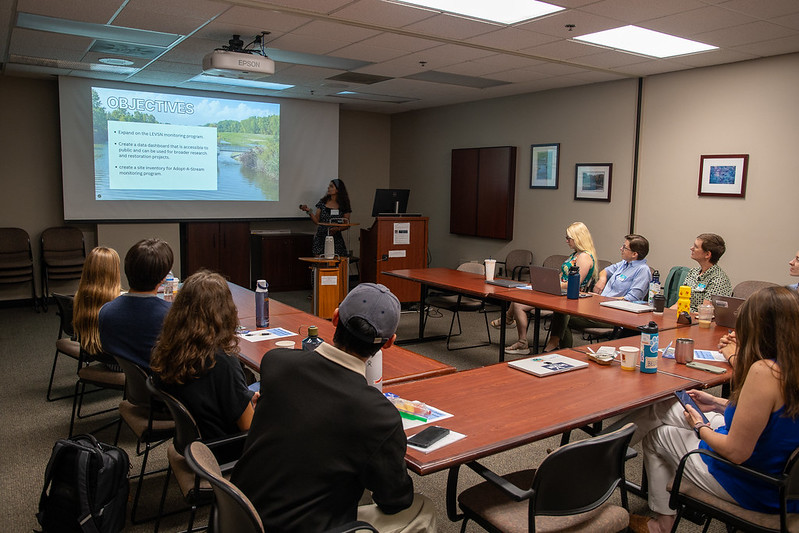
Last week, I wrapped up my Michigan Sea Grant Environmental Internship with the Clinton River Watershed Council (CRWC) and had the privilege of presenting the findings of my project at Michigan State University.
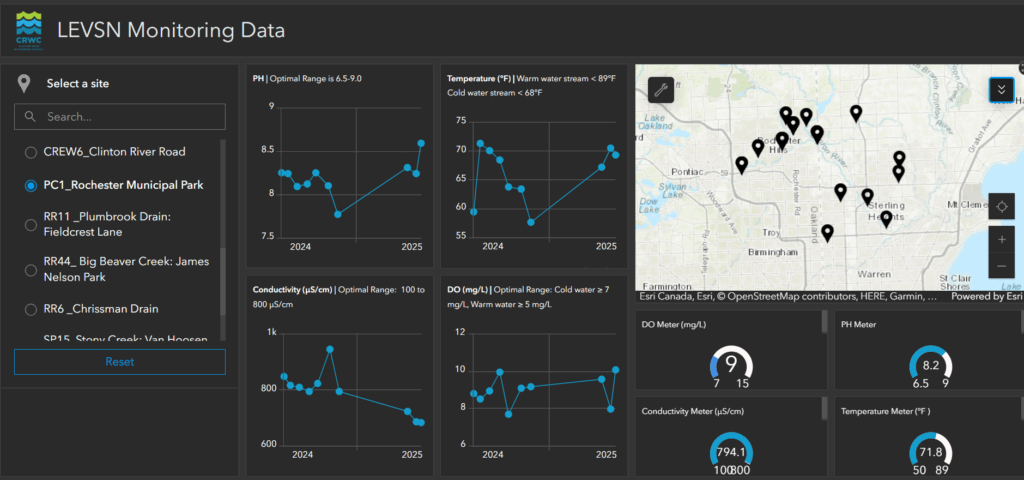
As part of my main project, I worked to expand the Lake Erie Volunteer Science Network (LEVSN) water monitoring program at the CRWC. With the support of my supervisor, Lydia Nicholas, and the network of volunteers I recruited and trained over the summer, we successfully monitored 15 sites across the Clinton River watershed in Oakland and Macomb County, many of which are in parks and public spaces where water quality directly impacts community use.
Each site was monitored twice a month, with data collected on pH, dissolved oxygen, temperature, conductivity, and total dissolved solids (TDS). All of the data will be uploaded to Water Reporter, a platform developed by the Cleveland Water Alliance to store and share water quality information.
In addition, I created an ArcGIS dashboard (soon to be published on CRWC’s website) that will give local communities public access to real-time water quality data and help residents better understand what these parameters mean for the health of their waterways.
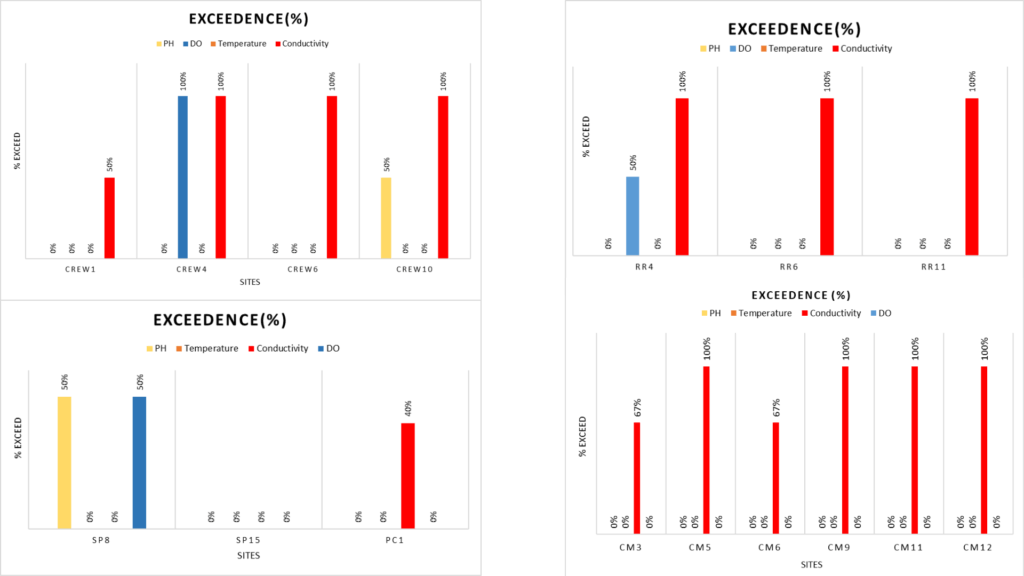
While continued monitoring is necessary for long-term insights, the early findings are significant: 13 of 15 sites exceeded conductivity thresholds in more than 50% of samples, indicating high levels of salts and metal ions in the water, which are largely attributed to road salt runoff, especially in urban areas. Higher conductivity levels threaten both human health and aquatic ecosystems, making ongoing monitoring and community awareness essential.
This internship has been an invaluable experience that has given me first-hand exposure to fieldwork and a deeper understanding of the challenges that come with it. Being out on the water, observing wildlife, and monitoring aquatic ecosystems not only gave me a more realistic picture of how these systems are changing, but also strengthened my appreciation for the beautiful water resources we have here in Michigan.
One of the most rewarding aspects of the internship was working with volunteers. Seeing their enthusiasm and commitment to protecting our waterways was truly inspiring and reinforced the importance of community-driven environmental stewardship.
Special thanks to Michigan Sea Grant, the Clinton River Watershed Council, and my supervisor, Lydia Nicholas, for their support and guidance in making this internship such a successful and insightful experience.