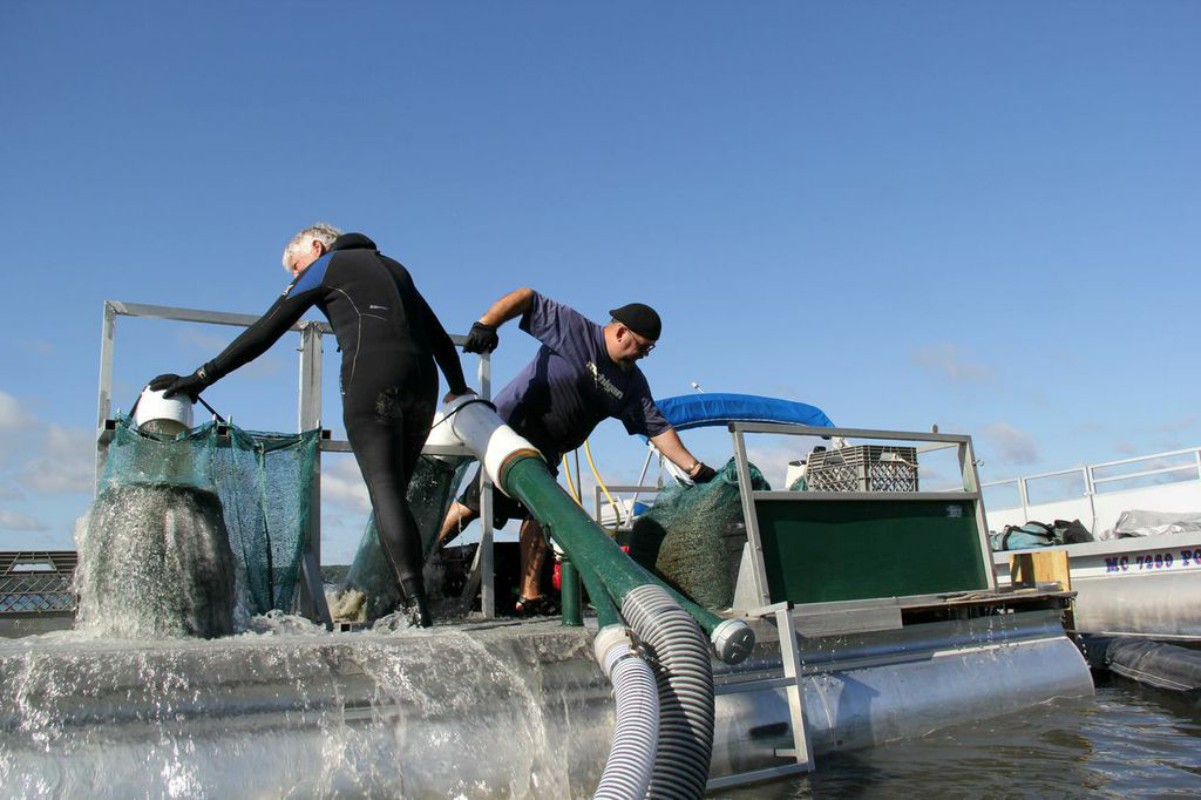
The diver-assisted suction harvesting (DASH) boat is used on Higgins Lake to remove invasive species. Photo: Higgins Lake Foundation
Michigan Sea Grant often receives questions from the public about lake management techniques. Recently we were asked about diver-assisted suction harvesting (DASH) and how it can be used to manage aquatic invasive species. Rick Meeks, a member of the Higgins Lake Foundation Board of Trustees and the Michigan Lakes and Streams Association board, shares how Higgins Lake has dealt with Eurasian water milfoil, an invasive aquatic species.
Tell us about Higgins Lake.
Higgins is a 10,000 acre lake. Its deepest point is approximately 135 feet. It is at the top of the Muskegon River Watershed. There is no commercial agriculture, industry, or mining in the watershed. The lake is mostly spring-fed, so the water is not affected by tannins (natural compounds found in plants). The water is very clear; you can see the Secchi Disk (a tool to assess lake water clarity by lowering it until it disappears) down to 40 ft. and beyond.
However, Higgins Lake has more public access than any inland lake in the state with two state parks, two marinas, and several public boat launches. The South Higgins State Park has about 450 campsites. The North Higgins Lake State Park has about 170. The state-operated West Higgins Lake Boat Launch has parking for around 100 vehicles with empty boat trailers. The lake gets a lot of visitors.
How did you know there was a problem with Eurasian water milfoil in Higgins Lake?
Twenty-five years ago, there was very little plant growth in the lake. Then we began to see small patches of what aquatic botanists identified as Eurasian Water Milfoil (EWM). The invasion had begun.
How did you decide to start using DASH (diver-assisted suction harvesting)?
I was part of a group of volunteers who fought the invasion of EWM into Higgins Lake for years. By 2010 we were becoming frustrated and overwhelmed by the increasing volume of the invasive plant. The group had spent years putting 15’ X 15’ cloth barriers on the bottom of the lake to block the sunlight necessary for the plant’s growth, buying and releasing weevils to eat the plants, and using a limited amount of chemical treatment. We were losing the battle. In more and more places the milfoil was growing up to boat propellor depth where it could be cut and spread.
That spring, I and some others from the group attended the annual Michigan Lakes and Streams Association Conference. There was a vendor there who was selling Diver Assisted Suction Harvesting (DASH) boats. We researched the concept, had the boat manufacturer demonstrate the boat in Higgins Lake, and recommended that the Higgins Lake Foundation (HLF) purchase one. The HLF board agreed and spent $40,000 on a new DASH boat.
After an intense period of securing DEQ permits (now EGLE – Environment, Great Lakes and Energy), hiring certified divers (as strongly suggested by our insurance carrier), procuring an ancillary work boat, purchasing dive gear (even though the divers work from 20 ft. hoses hooked to boat-mounted air pumps), etc., the boat hit the water in the summer of 2011.
How does the process work?

At Higgins Lake, the DASH boat and divers are used to help control Eurasian Water Milfoil, an invasive species. Photo: Higgins Lake Foundation
Once we were over the initial trials and errors, we developed a process that really worked. The divers grab the plant at its base and pull it out roots and all. They feed the plants into a 5” diameter suction tube, and then deckhands deposit them into large “onion” bags on the boat deck. In the summer of 2013 we removed 248 100-pound bags from the lake. Not only were we killing the plants, we were removing biomass from the lake.
What are your future plans?
The divers are still out there every summer working, but our recent annual bag count has decreased. This is understandable. We have people surveying the lake all summer long, and we know there’s less Eurasian water milfoil than there was 10 years ago. We feel that we’re staying up with the invasion and maybe even gaining on it.
The fight will never end. The source of AIS (aquatic invasive species) is constant; the removal process is expensive; and Higgins is a big lake. The cost to the Foundation for the divers, gas, insurance, boat and equipment maintenance, etc. averages around $45,000 per year.
Fortunately, the HLF board and our donors are committed to keeping the DASH boat on the lake.
What advice would you give other lake residents about DASH or invasive species management?
Obviously, any group considering invasive species control with a DASH boat will need funding. It’s also important to have the boat manufacturer demonstrate their boat on your lake to make sure it will work on your lake bottom. If it works and you have the funds, go for it. We are happy with our boat and team and the success we have had in limiting the amount of aquatic invasive species in Higgins Lake.
Learn more
Learn more about identifying and reporting aquatic invasive species through the free MI Paddle Stewards course! The course includes detailed instructions for using apps to report species you encounter, as well as information about aquatic invasive species in Michigan and local organizations near you who work on managing them.