For decades, Lake Huron has been a focal point of ecological change. While much of the public conversation centers on declining fish stocks or the visible spread of invasive mussels, a team of researchers led by Hunter J. Carrick, Ph.D., at Central Michigan University has been looking closer, much closer.
Their final report, concluding a multi-year study of Thunder Bay reveals a lake that has transitioned into an “ultra-oligotrophic” state. This state means that Lake Huron’s offshore waters have become a desert of sorts, where nutrients are scarce and the entire food web is now powered by the smallest organisms imaginable.
The report paints a picture of a Lake Huron that is vastly different from the one studied in the 1980s. It is a system that has become leaner and more reliant on microscopic efficiency. While offshore productivity remains low, the lake’s ability to reorganize its microbial community shows a complex, hidden resilience. As invasive species continue to shift the balance, understanding these invisible pathways is the only way to predict the future of the Great Lakes’ larger inhabitants.
Rise of the “Micro-Web”
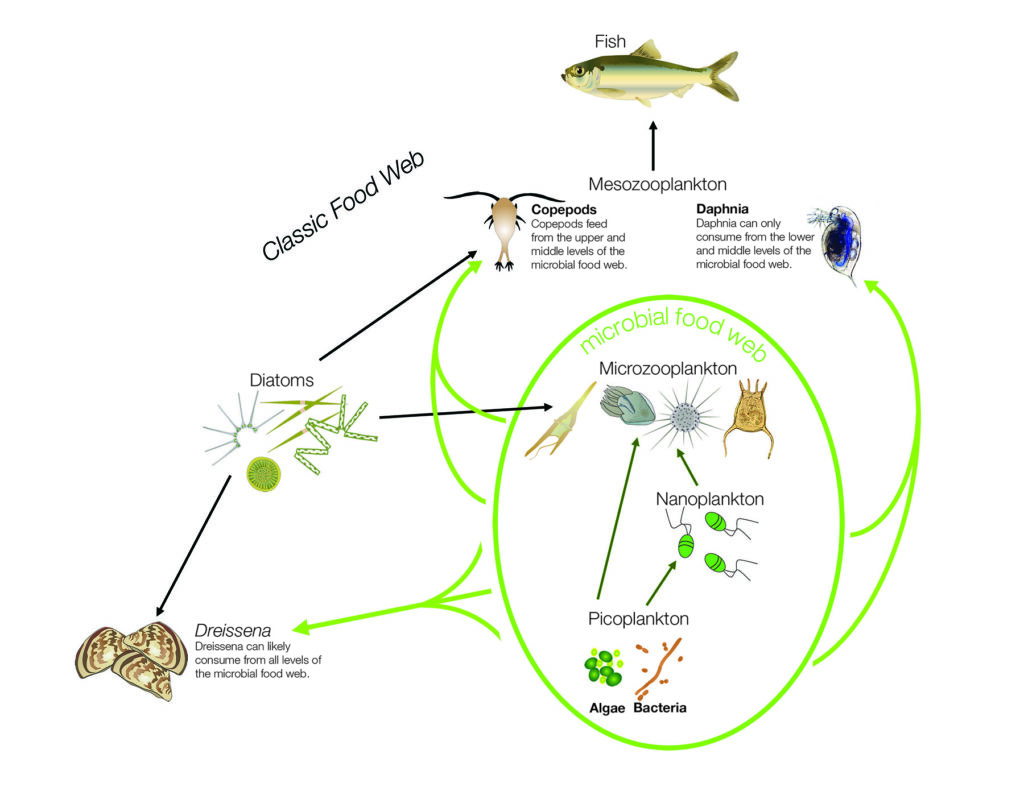
The study’s primary goal was to measure the “microbial food web,” or the bacteria and tiny algae that form the foundation of life in the Great Lakes. The findings confirm that Lake Huron has undergone a massive structural shift. Historically, larger plankton supported lake food webs, but today, the system is now dominated by picoplankton, cells so small that they are measured in microns.
In addition, most of the lake’s carbon and phosphorus, which are the building blocks of life, are now processed by these microscopic cells rather than larger plants. Despite these changes, the bacterial community in Thunder Bay remains remarkably stable and diverse across different depths and seasons. But while bacteria are steady, more complex microscopic life (eukaryotes) is in constant flux, reorganizing significantly as the lake warms and cools throughout the year.
To get these results, the team moved beyond the traditional microscope. By using DNA barcoding, a molecular technique used to quickly identify species using short gene sequences that act as a “fingerprint”, they were able to identify species that are often indistinguishable to the human eye. This genetic accounting showed that while the lake is low in nutrients, it isn’t necessarily “dying”; instead, it is reorganizing. For example, the research team found a significant presence of Cyanobium, tiny blue-green bacteria that thrive in clear, low-nutrient waters that now characterize the offshore Great Lakes.
The “Flea” Effect: An Unexpected Discovery
One of the most striking findings of this project involved the invasive spiny water flea (Bythotrephes sp.). Scientists used controlled experiments to see how this predator affects the rest of the food web, and the results revealed a trophic cascade, or significant change in how food moves through the food web. This change occurred because spiny water fleas eat medium-sized “grazer” plankton (like ciliates), which means these “middlemen” are no longer around to eat the tiniest picoplankton. As a result, these invasive fleas actually increased the abundance of the smallest bacteria and algae by removing their natural predators.
Investing in the Next Generation
Beyond the data, the project served as a training ground for future scientists. Dr. Carrick integrated the findings into his courses at Central Michigan University, and the project supported several students who conducted original research on everything from diatom shapes to how zooplankton grazing affects bacterial communities.