Earlier this year, Michigan Sea Grant conducted a survey of its partners and community to gather feedback on its current portfolio of research, education, outreach, and communication to ensure we are meeting the needs of Michigan residents while protecting Great Lakes resources. This information will be used along with other input to develop a strategic vision for the next four years, from 2028 to 2031, building on previous successes while responding to new challenges and priorities. The plan will also closely align with priorities and challenges identified by the National Sea Grant Office. Nearly 200 responses were received that provided input on research priorities, programming and activities, and outreach and products.
“It’s so reassuring to hear that so many of our community members believe Michigan Sea Grant is integral in creating Great Lakes data, products, and training that protect and enhance the health of the Great Lakes and those living in the watershed,” said Silvia Newell, Michigan Sea Grant director and professor at the University of Michigan School for Environment and Sustainability.
“Over and over again, respondents told us that MISG creates resources that are critical to the people and places in the region – fishers, educators, boaters, outdoor recreation professionals, researchers, data analysts, grant writers, historians, and more.” she added.
Overall, survey respondents indicated that MISG is an excellent collaborator, connector, and knowledge base for all things related to the Great Lakes. Specifically, participants ranked the highest priorities in each of the focus areas as follows:
- Healthy Coastal Ecosystems – aquatic invasive species received the most “high priority” votes (128), followed by habitat restoration (119).
- Sustainable Fisheries and Aquaculture – safe and clean ports, harbors, and marinas received the most “high priority” (90); followed by fisheries management support and planning (87); and citizen/community science for anglers (67).
- Resilient Communities and Economies – green infrastructure/stormwater management was ranked the highest priority (116); followed by coastal zone development/use/planning (98); and water infrastructure (90).
- Environmental Literacy and Workforce Development – K-12 classroom, outdoor, and shipboard education (98) received the most high priority votes; followed by community education (92); and place-based education (79).
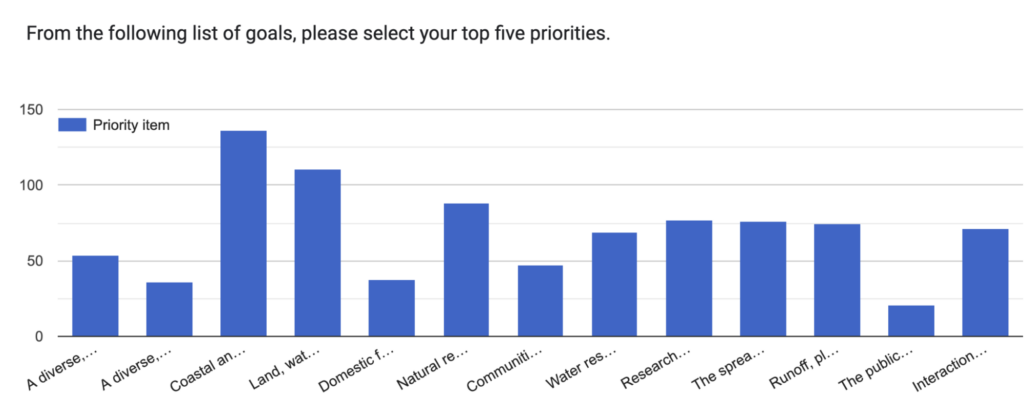
Respondents were also asked to rank MISG’s current goals in order of importance. The highest ranked goals out of all 13 were:
- Coastal and Great Lakes habitats, ecosystems, and the services they provide are protected, enhanced, and/or restored (136 votes).
- Land, water, and living resources are managed by applying science, tools, and services to sustain resilient coastal and Great Lakes ecosystems (111).
- Natural resources are sustainably managed to support coastal communities and working waterfronts, including commercial, recreational, subsistence fisheries, and aquaculture (88).
Respondents were asked to rate any MISG products that they have used, including newsletters, websites, fact sheets, reports or guidebooks, maps, posters, educational materials, and more. Of the products used, 94% of respondents ranked them in the two highest categories of quality. In addition, respondents ranked any interactions or engagement they had with MISG, including through one-on-one contacts, workshops, trainings, and other events and programs. Of these interactions, 93% of respondents rated them as high or highest quality.
Overall, respondents indicated that MISG products provide accurate, current, and unbiased information. One response said: “I appreciate the watershed maps/graphics, informational newsletters, and regional perspective of the products.” Another commented: “It has been my experience that MISG products have consistently maintained a high level of professional and technical integrity, but still delivered with a clear understanding of the target audiences for said products.”
Educational materials were also widely appreciated. One comment said, “Low or no cost to educators, always updated/current; wide variety of lessons; culturally relevant.” And another said: “We are grateful for the resources and partnership in growing place-based stewardship education across the state and look forward to continuing to work together to strengthen place-based teaching and learning in SE Michigan!” Another stated: “Thank you for all of the great lessons focusing on OUR Great Lakes. They have provided real-time data analysis for high school students.”
Several survey takers mentioned the value of information and resources for fisheries, including the workshops and the angler program: “Great Lakes Angler Diary is a fantastic program for collecting very useful data from anglers that would not otherwise be collected.” Another said: “The Great Lakes Angler Diary/Michigan River Steelhead Program has been amazing. The data gained and analyzed has been outstanding. … This program has been the best thing I have seen for steelhead biological understanding in my 34 years of steelhead fishing. The program must continue!”
Overall, survey respondents said they found the work of Michigan Sea Grant critical for connecting people with information and resources: “[T]hank you for the many ways in which you have a positive influence on our lakes!” Many stressed the importance of a program like MISG given the widespread societal and economic impacts predicted by increased pressures on the freshwater resource in the United States and beyond, both in conducting research to address resource management issues and improving public awareness and education.