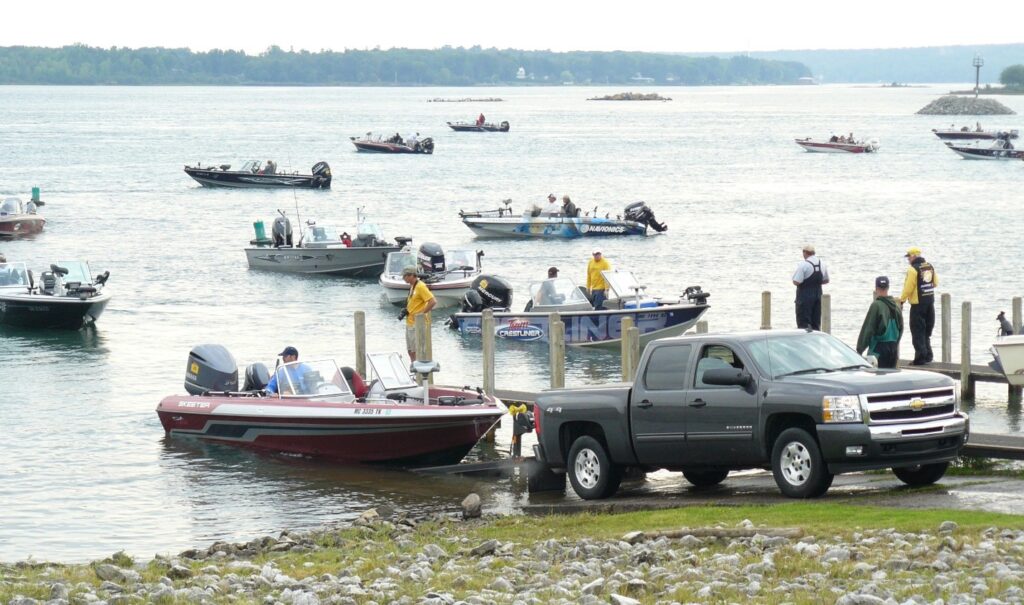
Boats line up to fish a walleye tournament in the St. Mary’s River. Events like this highlight the importance of recreational fishing to coastal tourism. Photo: Dan O’Keefe/MIchigan Sea Grant
Recreational fishing means many things to many people. For some, casting a line evokes fond memories of quality time spent with family and friends. For others, wading down a remote stream provides a break from screens and a respite from the rhythm of modern life. The thrill of catching a big one is the draw for some, while others are more motivated by the thought of fresh fillets sizzling in hot oil.
In Michigan, resident recreational fishing license sales rose from 1.1 million in 2015 to 1.2 million in 2025. The Great Lakes State offers anglers over 3,200 miles of coastline, over 11,000 inland lakes, and tens of thousands of miles of streams and rivers to explore. This makes Michigan a popular destination for out-of-state travel, as well. Although tourism is often the focus when demonstrating the value of recreational fishing, the food value of fish caught and the cultural, social, nutritional, and mental health benefits of fishing are often overlooked.
The term “sport fishing” is sometimes used interchangeably with “recreational fishing,” but the motivations of many anglers do not align strictly with sporting or competition-based activities. Some types of fishing are more focused on harvesting fish for food. Think of smelt dipping, where small, tasty fish are harvested with long-handled nets. Although it does not require much skill, it is a popular pastime that puts food on the table. At the other end of the spectrum, think of competitive events like catch-and-release bass tournaments where fish are not harvested at all.
Both are part of our recreational fishing heritage, and most fishing activity falls somewhere between the two extremes. Fishing for walleye in the Detroit River is a great example. It is certainly considered sporting, but how many people would fish for walleye if there was no opportunity to harvest fish?
The rising value of Great Lakes fish
Recreational anglers in Michigan waters of the Great Lakes harvested fish worth an estimated $67.7 million during 2025, which represents a dramatic increase from the $40.1 million harvested in 2022. Although inflation and the rising retail price of Great Lakes seafood contributed to this rise in value of fish harvested, increased recreational harvest of key species also played a role. According to a new Michigan DNR report, salmon harvest has been increasing in Lake Michigan in recent years, and both Lake Erie and Lake Huron have seen an uptick in walleye harvest since 2022. The recovery of walleye in Saginaw Bay contributed to making walleye the most valuable fish in terms of fillet harvest, with $24.3 million in walleye fillets harvested by recreational anglers in Michigan’s Great Lakes waters in 2025; Chinook salmon were the second most valuable recreationally harvested species at $20.0 million.
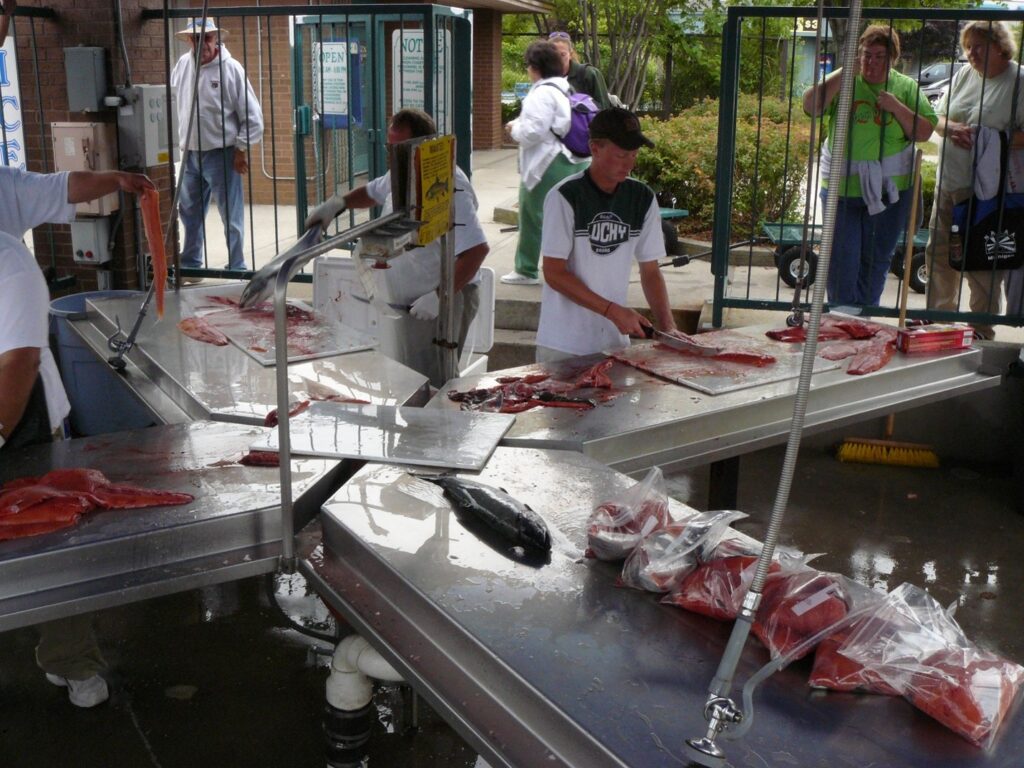
The fish cleaning station at Grand Haven’s Chinook Pier is a testament to the food value of fish harvested under a recreational fishing license.
Photo: Dan O’Keefe/Michigan Sea Grant
In 2025, the average size of a Chinook salmon caught by Lake Michigan anglers in Michigan waters was 9.7 pounds, with fillets weighing 5.4 pounds. The retail price of Great Lakes salmon available from online retailers in Michigan was $22.40/lb. in 2025. This means that the average value of a recreationally caught Lake Michigan salmon was just over $120 last year and a limit of five salmon was worth around $600. That is a powerful incentive to go fishing!
In southeast Michigan, walleye provide the most food value to anglers. Although smaller than salmon, they are the favorite table fare for many a fish fry. In Michigan waters of Lake Erie, the average walleye weighed 2.2 pounds in 2025, and an average daily limit of six walleye produced fillets worth $122.
Economic impacts of recreational fishing in Michigan
While the retail value of fillets harvested is impressive, the importance of recreational fishing to coastal communities is more often thought of in terms of economic impacts. These impacts include money spent on goods and services purchased in the pursuit of fish, and also the ripple effects of that spending. Together, these “total effects” are often used to measure the overall economic output of an industry or activity.
In Michigan, the most recent estimate of economic impacts found $3.9 billion in economic output attributed to recreational fishing in 2023. This was based on a national study conducted in 2022 and includes impacts from both Great Lakes and inland fishing in Michigan. A different study released by Michigan United Conservation Clubs in 2019 found $11.2 billion in economic output and 171,000 jobs supported by fishing, hunting, and trapping in Michigan. Since different studies use slightly different methods, the results are not always directly comparable.
For economic impacts specific to Great Lakes fishing, the most recent and most comprehensive information can be found in a Great Lakes Fishery Commission (GLFC) study published in 2022 (GLFC 2022). That study, which was conducted by Southwick Associates and collaborators, found an economic impact of $2.7 billion in economic output attributed specifically to fishing in Michigan waters of the Great Lakes waters and tributary streams. This is the same study that estimated an economic impact of $5.1 billion from recreational fishing in all U.S. and Canadian Great Lakes waters and tributaries. Michigan was found to be the regional leader in terms of employment, with 18,700 jobs attributed to recreational fishing in Michigan waters of the Great Lakes and tributaries.
Rob Southwick, Founder and Senior Advisor for Southwick Associates, provided a detailed explanation of economic studies at last year’s statewide Michigan Sea Grant fishery workshop (video online). In short, the GLFC study provided higher sample sizes and more detailed information specific to fisheries of the Great Lakes and tributaries, but it did not include inland fisheries as the national study did.
What do anglers spend money on?
The economic contributions of Great Lakes fishing are substantial – totaling more than the box office receipts for the top 10 movies of 2023. However, these impacts are less obvious than other drivers of the economy because they are spread across sectors.
The GLFC study provided a detailed look at fishing-related expenditures for each of the Great Lakes and each state and province. This included trip-related expenditures from food and ice brought at convenience stores to lodging, transportation, and fees for guides and access sites. It also included equipment expenditures like fishing tackle, rods, reels, and fish finders.
The study also captured major expenses for boats, trailers, vehicles needed to haul boats, motor homes, campers, cabins, and real estate. These big-ticket items were only counted if they were purchased for the primary purpose of fishing, though. The family SUV repurposed to transport a fishing kayak wasn’t counted, but the one-ton In Michigan, big-ticket expenditures like boats, vehicles, campers, and real estate accounted for 77% of angler spending. For some people, these investments are a lifestyle choice that brings them closer to high quality fishing and the enhanced quality of life. Beyond that, these purchases allow an individual to share fishing experiences with others. Owning a large fishing boat, a tract of wilderness land along a trout stream, or a camper at your favorite fishing port provides a place to invite others to share your passion for fishing and the great outdoors.
Fishing on a budget
The flip side of this is that fishing does not have to be expensive. A starter rod-and-reel combo can be purchased for under $50 and last for a decade or more. Fishing tackle is more expendable, but lures and hooks don’t compare to the expense of a pickup truck or real estate. The GLFC study found that the average Great Lakes angler in Michigan spent about $265 per year on fishing equipment, bait, and tackle (including rods, reels, fish finders, lines, lures hooks, sinkers, etc.).
Fishing can be a very affordable outdoor activity – particularly if you live close to quality fishing water and don’t need a boat. An Illinois Natural History Survey study of Chicago-area anglers found that the average angler fishing from shore spent only $6.96 per trip on fishing-related expenditures (excluding travel) while boat anglers spent $124.07. It is often true that boat anglers have higher catch rates than shore anglers, but when fish are abundant shore anglers can also catch plenty of fish for a fraction of the cost.
Ensuring abundant harvests
People in the Great Lakes region are well aware of how important fishing is to local economies and quality of life. The 2022 GLFC study found that Great Lakes residents were willing to pay a median of $83 for a one-time fee that would prevent even a modest 10% reduction in sustainable harvest of fish. One unique aspect of this study is that it included recreational anglers and nonusers who did not participate in fishing or have close friends or family who fish. Nonusers were willing to pay a $43 one-time fee to prevent a 10% decline in harvest, while those who had fished recreationally on the Great Lakes within the past year were willing to pay $476.
The study demonstrated broad-based support for sustaining Great Lakes fisheries and highlighted the critical role that recreational anglers play in supporting conservation efforts. Recreational fishing license sales fund fish stocking efforts, habitat improvement, and the research that is necessary to ensure sustainable harvest by setting appropriate limits and fishing seasons. Excise taxes also provide funding for the Sport Fish Restoration Program through a 10% tax on most fishing tackle (and a lower 3% tax on certain items like electric trolling motors, tackle boxes, and bait containers).
Costs and benefits
In Michigan, recreational anglers may soon be required to pay a bit more for a fishing license. While rising costs are rarely celebrated, it is undeniable that recreational anglers benefit tremendously from Michigan’s bountiful waters. While an extra $4 to $7 in your pocket might buy you a new lure or a fast-food value meal, it isn’t much compared to the value of a single salmon in the box or a limit of walleye on your stringer. Beyond that, the satisfaction of contributing to conservation of our world-class freshwater fisheries may help to soften the blow.
References and Notes on Calculations
Harvest Estimates
Total number of fish harvested under recreational fishing licenses was provided by Michigan Department of Natural Resources (DNR). Patrick Hanchin provided the weight of fish harvested in Lake Michigan during 2025 for most species (see Harvest of Fishes from Lake Michigan during 2025 for a summary). For some minor species in Lake Michigan, and for all species in Lake Superior, Laker Huron, and Lake Erie, the number of fish harvested during 2025 was reported in supplementary materials for DNR Fisheries Report FR049. The number of fish harvested was multiplied by the average weight of each species, which was provided by Christopher Kemp.
Whenever possible, the average weight used for a given species was based on 2025 biodata for each lake. Some minor species did not have associated biodata available for each lake, so average weights from previous years or other lakes were substituted. For example, average weight of Northern Pike was not available for Lake Erie in 2025, so the average weight of 3.7 pounds from Lake Michigan was also used for Lake Erie. Harvest estimates and average weights from 2025 were not available for Detroit River and Lake St. Clair, so the most recent values available were used (2022 for Detroit River, 2021 for Lake St. Clair).
- Su, Z., C. Kemp, E. Morrow, and M. Vaas. 2026. 2025 Michigan Great Lakes recreational fisheries: creel surveys, charter reporting, and historical trends. Michigan Department of Natural Resources, Fisheries Report 49, Lansing.
Fillet Yields
The yield for each species was determined using references below when possible. When yield was not available in published references, a surrogate species of similar shape was used (e.g., bluegill was used as a surrogate for pumpkinseed). Yield was multiplied by biomass harvested to generate an estimate of the weight of skin-on filets harvested for each species.
- Estimation of Daily Per Capita Fish Consumption of Alabama Anglers
- Pacific Seafood Recoveries and Yields
- Production of Walleye as a Potential Food Fish
- Fillet Weight and Fillet Yield
- Burbot May Look Odd but it Can be Tasty
Online Retail Price of Great Lakes Fish
Websites below were accessed in 2025 to assess the online price of Great Lakes fish filets. Whenever possible, the price of frozen skin-on filets from fish caught in Great Lakes waters and sold by U.S. retailers was used. When multiple vendors offered the same species, an average value was calculated. Burbot were not available from U.S. retailers, so Canadian retail price was converted into U.S. dollars. Prices were based on burbot harvested in Canadian waters of Lake Erie, and prices for northern pike were based on pike harvested from other Canadian waters. When prices were not available for a species, a surrogate species of similar value was used (e.g., lake whitefish was used as a surrogate for round whitefish). When no closely related surrogate was available, as for suckers and freshwater drum, the national average retail price for frozen finfish from Circana data was used.