Michigan State University and the University of Michigan may be rivals on the ice hockey rink — but when it comes to researching icy lakes, they’re on the same page.
Michigan Sea Grant (MISG) represents a unique partnership between the schools, with federal funding from NOAA. MISG funds and conducts research, outreach, and education about Great Lakes ecosystems and communities.
Winter is a notoriously difficult season for collecting Great Lakes data. High winds, strong waves, and ice cover make it hard for human researchers and underwater equipment to collect and analyze water samples.
But these seasonal gaps are missing important data. Winter conditions can have lasting effects on the Great Lakes’ biological, chemical, and physical processes throughout the year. Additionally, warmer winters and lower ice cover are driving new and unpredictable shifts in water levels, water quality, ice cover, and fish populations. Collecting cold-weather data is key to advancing restoration projects, fisheries management, and climate research.
Here are a few ways MISG and partners are working to address these gaps:
Within REASON: Expanding Great Lakes monitoring through protected sensors
Michigan Sea Grant funding enabled a binational research team to install water quality sensors along the St. Marys River between the Upper Peninsula and Canada. The sensors are tucked inside hydropower stations where they can collect data without being exposed to harsh weather conditions. Learn more about the project.
Winter sampling helps bolster fisheries, water quality, productivity, and biodiversity
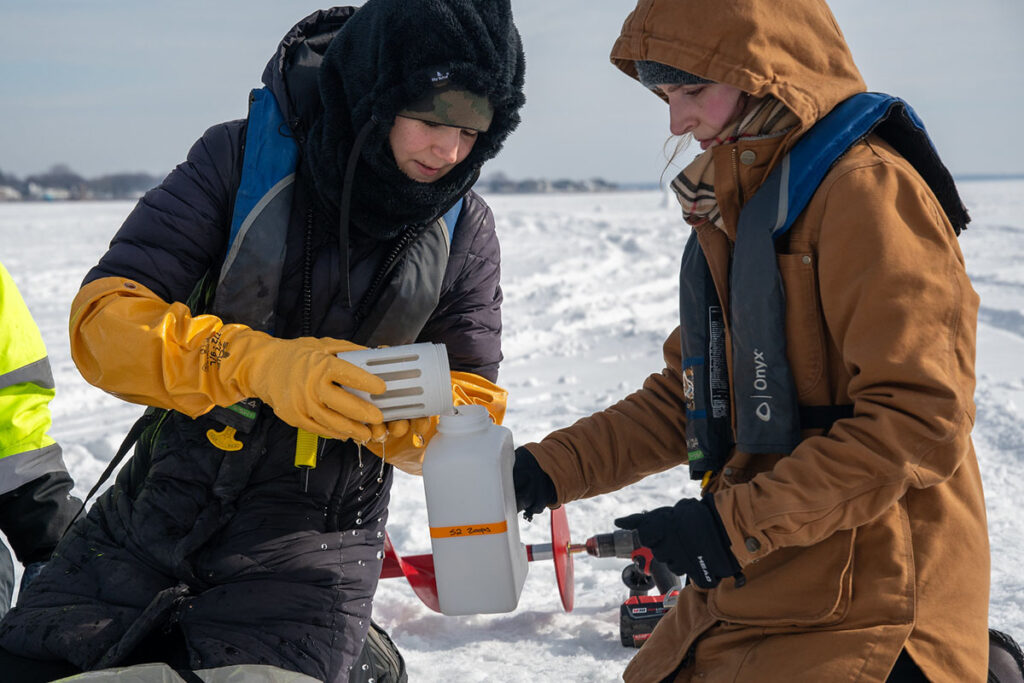
Thanks to MISG funding, Tristy Vick-Majors at Michigan Tech University has been coordinating “winter grabs” of hard-to-get water samples. In February 2025, multiple groups of researchers across all five Great Lakes ventured onto the ice to retrieve samples. MISG director Silvia Newell joined researchers from Oakland University to collect samples from beneath Lake St. Clair’s ice near Detroit. Learn more about the project.
Tracking and modeling Great Lakes ice cover
MISG and NOAA’s Great Lakes Environmental Research Laboratory (GLERL) are both part of the federal Great Lakes research ecosystem. GLERL has been exploring the relationships between ice cover, lake temperatures, and regional weather for over 30 years. Today, using satellite data and smart water sensors, GLERL can create near-real time graphics of Great Lakes ice cover. Check out current conditions and use this interactive graphic to explore annual shifts in ice cover from 1973 to 2025.
Eastern Upper Peninsula birding update: Winter birds and where to see them
Michigan Sea Grant Extension Educator Elliot Nelson shares an annual winter birding report, full of tips and tricks for spotting snowy visitors in the Upper Peninsula. Get his fresh take on birding in 2026. Birding is more than just a great way to explore Michigan’s urban and natural areas — birders can help advance research by logging their sightings in apps like iNaturalist and eBird. Scientists use these participatory science datasets to track trends in bird populations and prioritize conservation needs.